A Look Inside: WandaVision & The Stages of Grief
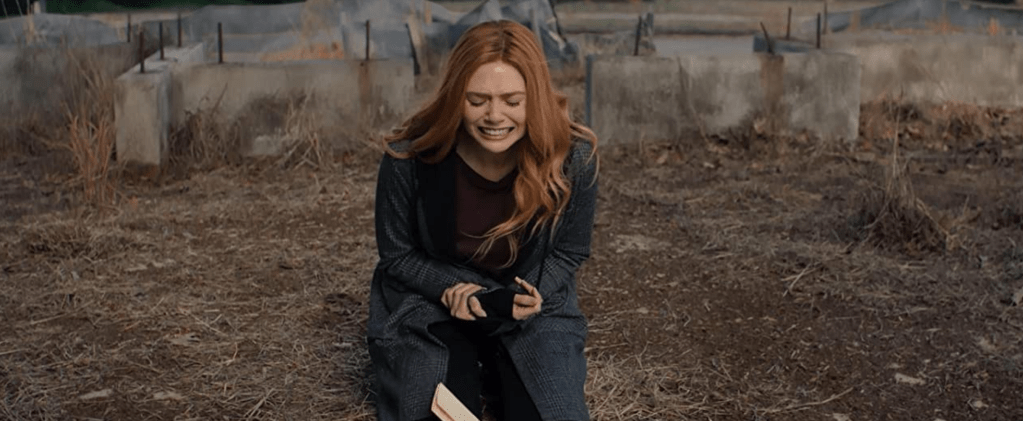
While the hype and excitement for the first Marvel & Disney+ series has died down, I wanted to take some time to talk through the overarching themes of grief and trauma and how they are portrayed in the series. Since the beginning the character of Wanda Maximoff (Elizabeth Olsen) has captured my attention, in part because of Elizabeth Olsen but also because of the darkness and mystery that has surrounded her character. Upon her introduction in the post-credits scene in Captain America: The Winter Solider – I knew there was something there and I am glad Marvel continued her story even more with WandaVision. Perhaps more than any other MCU project, WandaVision sets out to tell its own unique story that puts much of the action-packed fighting in the back seat as it confronts its thematic elements head on. This is where we turn to Wanda’s grief and trauma which serve as the basis for the series. It’s crucial to remember that, for her, not much time has passed since Vision died and the events in Avengers: Endgame. Her internal wounds are still fresh and her grief is palpable and unrelenting. From the start WandaVision nails grief and the 5 stages (generally) association with grief and trauma which are denial, anger, depression, bargaining and acceptance. While the psychology community has since abandoned this idea of the 5 stages of grief, it is still an effective narrative structure that WandaVision weaves seamlessly into its story.
The narrative structure and how the story is told plays a huge part in the 5 stages of grief and trauma, not only that but even the subtleties of the commercial breaks play a part in understanding Wanda’s grief and how it has plagued her, her whole life. That mixed in with the sitcom form of the series, we are shown one of Wanda’s true comforts in life which were the sitcoms her family watched back in Sokovia to learn english and also entertain themselves to escape the realities of war happening outside their windows. All of this plus the incredible performance of Elizabeth Olsen and Paul Bettany make WandaVision one of the best series I’ve seen this year and I am happy that Marvel decided to elaborate on the undertones of emotions that generally follow most of the Avengers (think of Tony’s journey in the Iron Man movies & dealing with PTSD). By taking a step back to focus more on emotions rather than fighting evil, we were able to truly understand the character arc of Wanda Maximoff. With that let’s start with understanding the first stage of grief, denial, and how it is portrayed in the series.
Denial
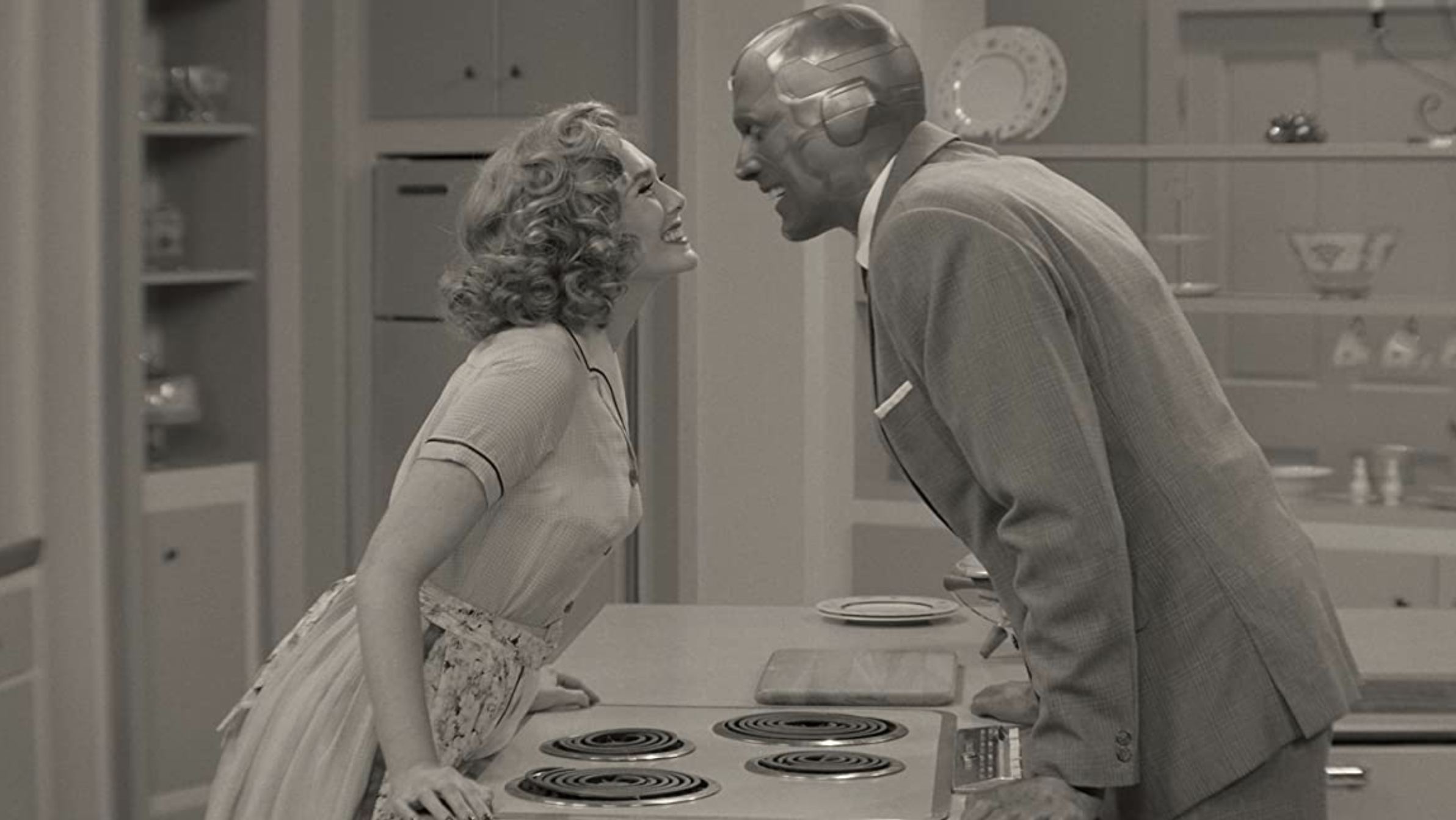
Denial is perhaps the easiest stage to identify in general and with Wanda specifically. When the series opens, we the audience know that Wanda is mourning the loss of Vision from previous MCU films. It is important to note that this information is crucial to understanding what Wanda is going through during the series and especially in the beginning even though we don’t immediately know where exactly in the timeline this story takes place. Heading into the first episode I wasn’t exactly sure what to expect but in the beginning, we see Wanda has immersed herself in a self-constructed fantasy land of black-and-white, sweet sitcoms where she and Vision live ‘happily ever after.’ Fairly quickly we learn that her powers essentially allow her to externalize the internal process many people go through when they grieve, refusing to accept a world in which something that means so much to them is absent altogether. Sadly, it doesn’t take long for the cracks to appear in Wanda’s fantasy, and the more they do, the more she leaks into the next stage: anger.
Anger
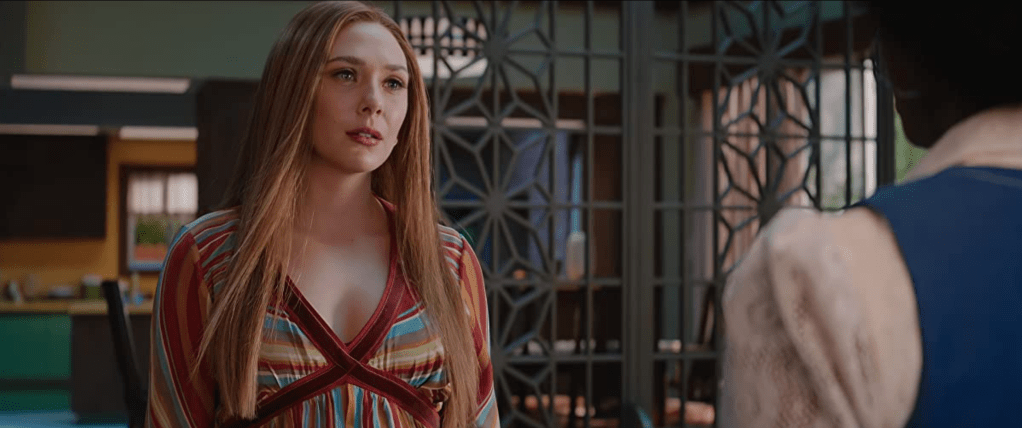
Initially we are really only shown her denial regarding her situation but episode 3 is when we really start to see her attitude shift. Anger is used as a self-defense mechanism to guard against the threat to the fantasy created in the previous stage, it helps the grieving party to feel in control of a world where they are losing power and to inflict the influence they do have on things that are small enough for them to manage. For Wanda, those threats add up as idle curiosities like the colorful toy helicopter and Dottie’s bleeding hand in episode 2, but they finally explode into outright anger when Monica Rambeau (Teyonah Parris) confronts her about the outside world and the loss of her brother, Pietro to Ultron. Wanda is taken back by the realization of the outside world and her response is to banish Monica from Westview by throwing her out of the Hex. Just as she willfully reset her reality earlier with the beekeeper, Wanda’s anger guards the manageable world she has created for herself and allows her to take control. But more and more, her degree of influence weakens, with instances like the stork, the twins’ rapid advancement and S.W.O.R.D.’s infiltration of Westview serving as stark reminders of the limitations on her control and the world she has created. The less she can fight against those influences, the more she needs to resort to bargaining, which is the next step in her stages of grief.
Bargaining
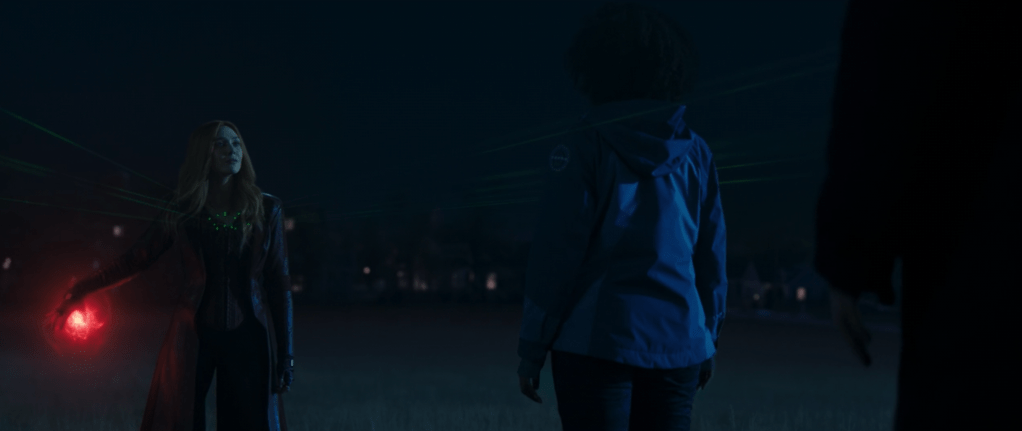
In the bargaining stage, the mourning begins to accept that they can’t intentionally resist the changes of the world around them or in Wanda’s case, the world she has unconsciously created. At the same time, they are still far enough from the stage of acceptance that they believe there are negotiating measures they can take to ease their suffering and hold on to their happiness. For Wanda, this becomes abundantly clear when she storms out of the Hex to confront S.W.O.R.D. following their attempt to kill her with a missile. She is more lucid than ever, back to using her familiar accent, and even threatens the agents to leave her alone and allow her to maintain her fantasy. It comes at a vital point in the story where we are questioning just how conscious Wanda is of the changes around her and whether or not she is an active agent in shaping them. While it is obvious her powers grant her some control over Westview, there is a lingering mystery about the aspects which she can’t control, and those aspects come to a head when her brother ‘Pietro’ (Evan Peters) seemingly reappears at her front door. Though Wanda’s self-doubt begins to plague her, Pietro’s reappearance at the end of episode 5 seems like a win in her negotiation with the universe and she readily accepts the compromise for her happiness it seems to represent…at least, at first. It is here where we start to see that Wanda is completed crippled by her own self-doubt that she actually believes Pietro was real.
Depression

A natural stage of any form of loss is depression and eventually, there are just too many questions Wanda needs to ask herself and the illusion becomes too difficult to maintain like many of those dealing with such a loss. In recognizing her own limitations and inability to create a flawless paradise, her control begins to break down completely as we start to see in episode 7. Known as the depression stage, Wanda embodies many of its characteristics with familiar symptoms like apathy, doubt and self-deprecation that eat away at her. With her loss of control over herself comes a literal loss in control over her reality as objects shift and flicker between one state of existence or another. As she questions all of this, Agatha (Kathryn Hahn) reveals herself to deconstruct the remains of Wanda’s self-esteem. Episode 8 was by far the best of the series, not only because it was such an emotional episode but because we really begin to understand Wanda’s trauma and the grief she has experience throughout her life. Eventually powerless and forced to search through her own memories of the past for meaning, Wanda hits rock bottom in terms of her depression. But just as in the real world, it is there that she discovers a cherished memory with Vision that will finally allow her to move on to the final stage.
Acceptance
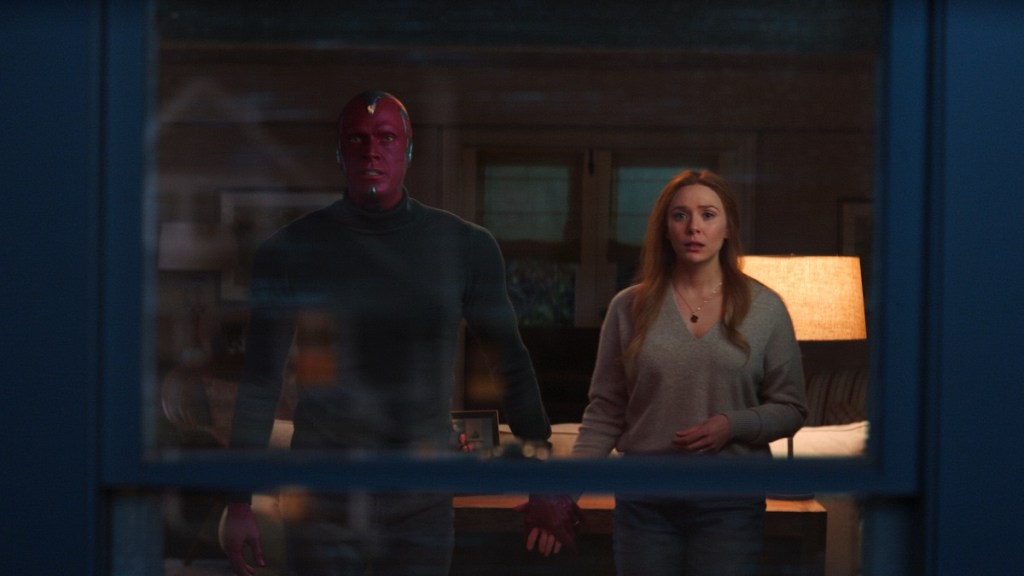
The POWERFUL line “but what is grief, if not love persevering?” comes in Wanda’s memory and episode 8 really helps us understand why this loss is so huge to Wanda. Vision was the one person that was there to help her pull back from the darkness and helps her realize that her grief over losing her parents, her brother and now Vision is really her love persevering. It’s proof that those who are “gone” never really leave us, our persistent love keeps them alive. After going through the final moments before she created this fantasy we see her heart truly breaking and we see how powerful those emotions can really be. Soon after these realizations, she regains her resolve to fight back against Agatha. Finally uniting with her family and wielding the full force of her powers, Wanda not only overpowers Agatha, she resists the temptation she offers to live in blissful ignorance in the illusion of Westview.
Episode 9 dives into understanding that grief not only effects you but effects those around you. While grief is a natural part of life, sometimes it can hurt those around you and that part is really represented with the residence of Westview. Finally, Wanda realizes her responsibility to those she has hurt and the importance of accepting reality, she finally comes to terms with her grief. With Agatha defeated, Wanda willingly gives up the love of her life and her children as she watches reality approach them, leaving her standing in an empty lot. It is only the in the post-credits that Wanda takes time to herself isolated in the wilderness, seemingly content but at the same time, there is an astral projection of Wanda at work, mesmerized by her studies with an ethereal look, removed from reality. She hears the cries of her children and the series ends, leaving us wondering which Wanda is left: the one who lives on in healthy acceptance taking time to herself, or the one secretly scrambling to regain the control she once had and possibly suffering delusions that return her to the start of the cycle? Only time will tell.
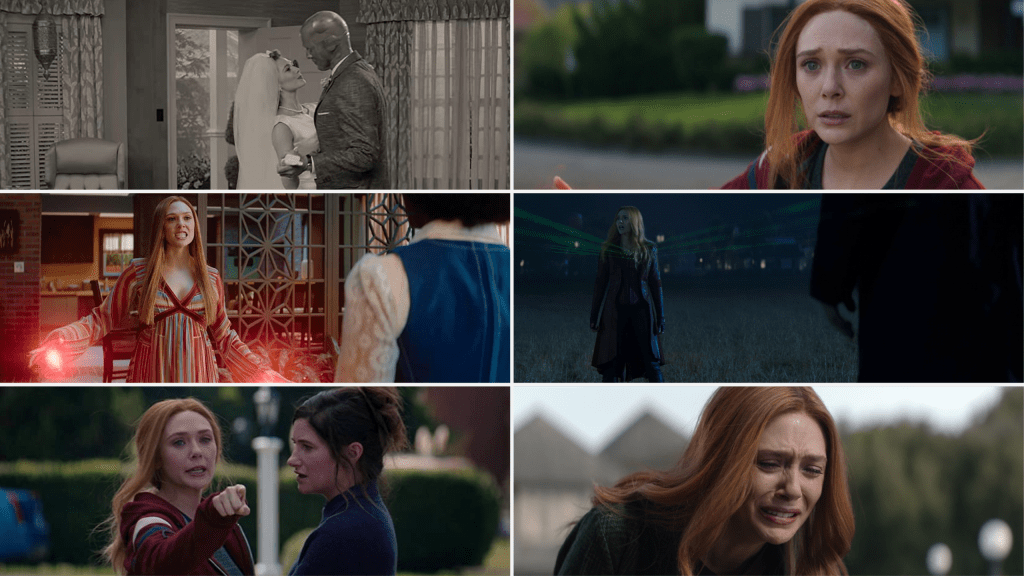
WandaVision‘s embrace of Wanda’s arc was so refreshing to see in the MCU and their desire to further explore her story and to grant her a space to grieve is gracefully executed in the series. For many of those who have experience a loss of any kind can relate to Wanda and her story on some level and this aspect makes it a delightful addition to the Marvel Universe. Yes even despite all the criticism (even from myself initially) that some fan theories didn’t come to fruition, we were given an emotional journey of understanding Wanda’s grief and trauma. Looking back and rewatching the series I was able to really appreciate these themes even more and I did appreciate that we were finally introduced to The Scarlet Witch and how her powers came to be.
 The Fade Out: A Movie Blog