A Look Inside: The Queen’s Gambit

WARNING: Contains Spoilers!
In October of last year Netflix released The Queen’s Gambit and just after four weeks it had become Netflix’s most-watched scripted miniseries. The series dramatizes the unprecedented rise of (fictional) chess prodigy Elizabeth Harmon (Anya Taylor-Joy) through the grandmaster ranks of chess champions in the 1950s and ‘60s. The series is based on Walter Tevis’ 1983 novel of the same name and like other prodigy books or TV series, there is a dark side to Beth’s talents. While she clearly possesses a natural affinity for creative and complex chess moves, Beth also struggles with her growing drug and alcohol addiction, which she believes allows her to prevail in so many nerve-racking chess matches. Even before she touches a pawn for the first time, there are these little green tranquilizer pills that define Beth’s life and ultimately her value, from her very first day at an all-girls orphanage in Kentucky. With gripping visualizes, cinematography, direction and acting we are shown the rise of Beth Harmon and her intense struggle with the fine line between addiction and obsession.
As the series opens we quickly learn not that she is a chess prodigy but she is a fuck-up running late for a match after waking up in a bath, fully clothed, as someone knocks on the door. From that we are taken back several years to the turning point in little Beth Harmon’s life – the moment she became an orphan and lost her mother in a car crash. Like many children who face this kind of childhood adversity this is a defining moment in her life either for better or for worse. At the scene of the accident where her mother was killed one of the cops mentions she had no scratches on her from the crash and called it a miracle but the other cop states “I doubt she will see it that way.” This sets a strong tone for most of the series as this will be the personal struggle Beth deals with for several years. Arriving at the Kentucky orphanage is yet another pivotal moment in Beth’s life – it is here where both obsession (power & control) and addiction (green pills) are born and it is also where the two become intertwined. After a quick tour of the orphanage young Beth (Isla Johnston) is put in line to wait for her cup of daily “vitamins” as they like to call them. Here we are introduced to an older girl named Jolene (Moses Ingram), who later becomes Beth’s best friend during her time at the orphanage. Jolene immediately advises Beth to wait and take the green ones right before bed, “otherwise they turn off right when you need them to turn on.” Not following Jolene’s advice on the first go around – Beth begins to stumble and starts to experience the full effects of the green pills.

While Beth’s reactions to the sedatives initially seem quaint, it soon becomes clear that she has become dependent on them. Beth comes across the game of chess when she’s sent on an errand to the basement of the orphanage where she also meets custodian, Mr. Shaibel (Bill Camp). The game immediately makes sense to her — when nothing else in her life does — and at night she runs through the moves he teaches her on an imaginary board she sees among the shadows of the dormitory where she sleeps. We are shown several scenes in which she takes multiple green pills to help her with her chessboard visualizations, immediately indicating to us that she believes these pills help her in studying the game intensely. Early on in her chess lessons with Mr. Shaibel, Beth makes an error and loses her queen and he explains that her next move is to resign (or more importantly accept failure). While that isn’t an official rule of the game, but rather a convention of good sportsmanship, Beth refuses to resign. Instead she throws a tantrum and Mr. Shaibel tells her to leave he then he locks her out of the basement for several days, depriving her of the ability to play chess with him, which is the only joy she’s found in the orphanage. But why does he engage in this act of tough love?
As Beth’s ‘surrogate father’ figure, he knows that if she doesn’t start learning how to manage her emotions and control her impulses now, she won’t just have trouble winning at chess; she’ll have trouble winning at life. This moment encapsulates the overarching theme of The Queen’s Gambit: Beth’s biggest obstacle is never going to be learning how to master the game of chess; it’s learning how to master herself. Mind you all of this unfolds within the first episode of the series, which like I’ve mentioned before sets the tone for the rest of the series. We see Beth become obsessed with power and winning but she has also becomes accustom to the safety and control that chess provides her – something she’s not lived with for sometime it seems. By taking the green pills at night and visualizing the matches she’s played earlier in the day we see her obsession and addiction intensify significantly within a short amount of time. However, soon after her arrival, the orphanage stops administering the green pills after they are banned for their habit-forming tendencies—but by then Beth is experiencing withdrawal symptoms.
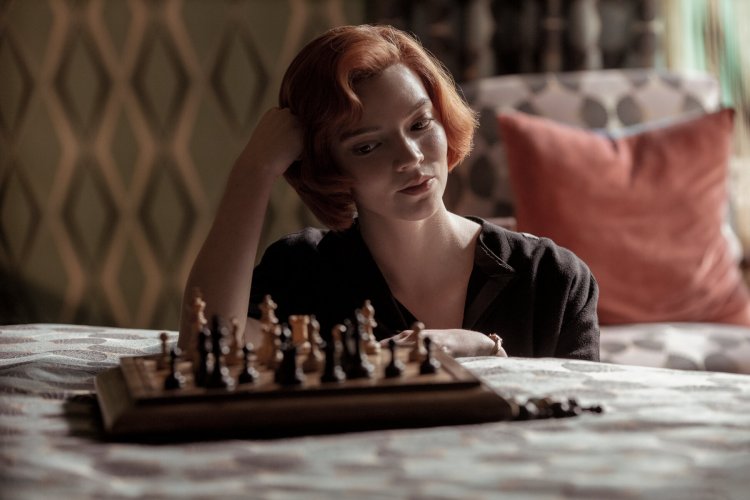
When looking at the line between addiction and obsession – both are easily defined and categorized as their own. For example when you think about addiction, you think about drugs, alcohol, tobacco, and maybe shopping or gambling. When a person is addicted to drugs or alcohol, they are chemically dependent on the drug. People who suffer from addiction many times also have other co-occurring disorders, such as obsessive/compulsive disorder. There is a strong correlation between addiction and obsession and the two are often linked together and in this case we are shown a character who is struggling with both. Beth truly feels for most of the series that the addiction to the green pills and eventually alcohol helps her maintain the success she has gained while playing the game of chess, obsessively. They have numbed her but they are also what she believes keeps her emotions in check. Beth finds a refuge in chess — it’s a predictable place where she feels safe and in control (both of her emotions and the outcome) thus leading to her need or obsession to continually engage with the game. Throughout the series we are shown why she needs a refuge, beginning with flashbacks to life with her brilliant, troubled biological mother (Chloe Pirrie) and continuing through her teen years with her alcoholic, depressed adoptive mother (Marielle Heller). Children who encounter some sort of childhood adversity sometimes end up struggling with addiction, depression or anxiety.
All of the moments we are shown of Beth’s past with her biological mother and even to an extent her adoptive mother – are moments far beyond her control. She is often told what to wear, how to act and what to do. Like many children, this can often lead to a need for an outlet and as we discovered the refuge was chess and it is one of the few things in life that she can truly control which adds to her obsession with the game. As she grew up we see this intense dynamic within Beth and she has the overwhelming fear of failure or losing control and it is often stated that fear leads to obsessive behavior. The fear of failure and of losing control stops Beth from being able to control her emotions and when individuals are unable to control emotions they often turn to substance abuse and in her case she finds comfort in the green pills and eventually alcohol. By putting obsessive and addictive behavior together the desire to avoid fear and escape only intensifies as we are shown in episode 6 of the series. It is in this episode where Beth turns to heavy drinking because she is lonely and in part to punish herself for the fuck-up in Paris and then when she begins to feel too much she takes the green pills to counteract it. It is here where that fear of failure / losing control has spiraled into a full self-sabotaging attitude because that feeling of loneliness can only be filled with the drugs and alcohol. Even from an early age she was told she’d be alone and she needed to learn how to take care of herself. And as she got older this idea of ‘taking care of herself’ meant taking drugs and using alcohol to cope with that loneliness she felt and her inability to have a firm grip on her emotions and how to control them in moments of frustration.

It is not till midway through episode 7 (the final episode) where Beth truly learns the lessons others had been wanting to teach her. Throughout the series Beth has genuinely made friends within the chess community and subsequently drove them away with her inability to handle her own emotions and her addiction. Despite her actions those around her still care to see her succeed in beating the Russians at their own game. The last episode brings everything together beautifully and shows us (and Beth) that even though chess is seen as an individual sport, it is important to have others around you to help and support her, just as her adoptive mother had. The relationships she has cultivated help her understand that the success she seeks not only depends on her but also on those around her. With the realization that Mr. Shaibel truly did care for her and followed her career up until his death, helped Beth come to the conclusion that she isn’t alone in this world and people do care for her unlike what her mother had conditioned her to believe. This moment helps Beth break free from her dependency on the green pills and alcohol because she realizes she isn’t alone and she is strong enough to take control without them.
The beauty of The Queen’s Gambit not only exists in its strong visualizes or costume design or acting but also how it showcases the delicate balance many people struggle with when suffering from addiction or even a behavioral disorder. Beth’s biggest obstacle throughout the series was never going to be learning how to master the game of chess but it was about learning how to master herself and her emotions. Issues like addiction and obsession often lead to loneliness (or vice-versa) and we saw first hand how Beth drove away everyone in her life and hit rock bottom before realizing that she does not need drugs or alcohol to fill the void she has felt for most of her life. Understanding that human relationships and connections are some of the most important things in life helped Beth in overcoming the dependencies she felt on the drugs, alcohol and chess. Having this realization not only helped her in reaching her goal (beating the Russians) but it also helped her break away from that obsession with power and control and let her just enjoy the game of chess as she once did.
“Creativity and psychosis often go hand in hand. Or, for that matter, genius and madness.”
Samantha Soule, as Jean Blake (Life Magazine Reporter)
 The Fade Out: A Movie Blog