A Look Inside: Her

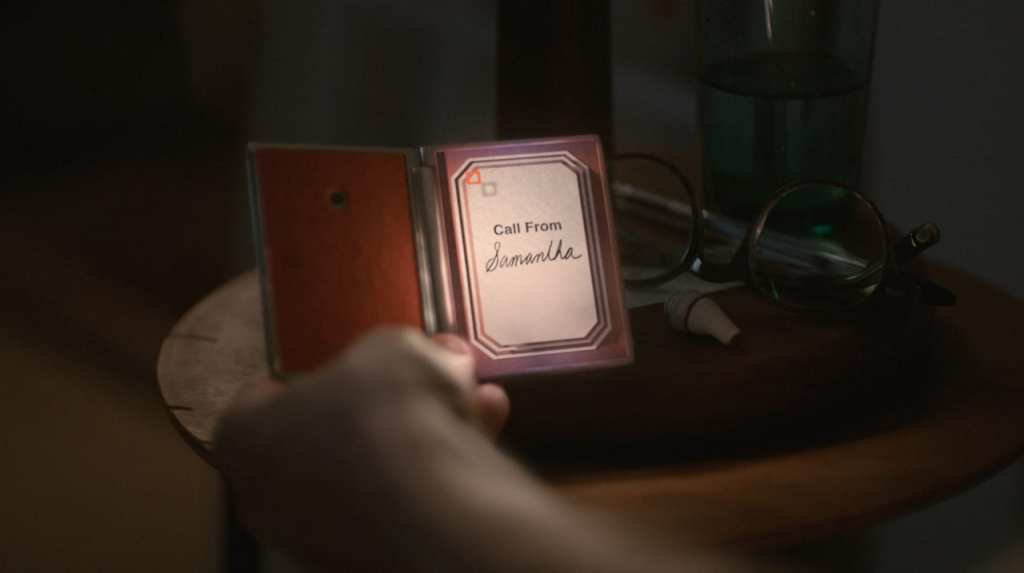
Spike Jonze’s film Her came out in 2013 and for some unknown reason it took me 7 years to finally watch it but I am so glad I did because there are so many wonderful and beautiful things about this film. In my last analysis on Ex-Machina (Alex Garland, 2014), I discussed the relationship between human communication and technology and the possible negative implications of technology and the way people interact. Today in honor of the incredibly talented Joaquin Phoenix turning 46 tomorrow, I’d like to explore that concept a little more with an analysis of Her which was written, directed and produced by Jonze. Her portrays a romantic relationship between a man, Theodore Twombly (Joaquin Phoenix) and a piece of software or more specifically an operating system that goes by the name of Samantha (voiced by Scarlett Johansson). On the surface that is what the film is about but if you’re like me by the end of the film you’ve come to realize there is something deeper than that and you start connecting your own life events with many of the high-concept existential ideas that the film raises. Questions like; what does it truly mean to love someone, what purpose does love give to our lives and why are we here? It is within the film’s first few shots that we are given the techniques and themes that will be used to address and answer these types of questions. Although while at it’s core Her is a love story unlike what you’ve ever seen before, it is more of a character study around Theodore’s path to find purpose and his desire to overcome loneliness.
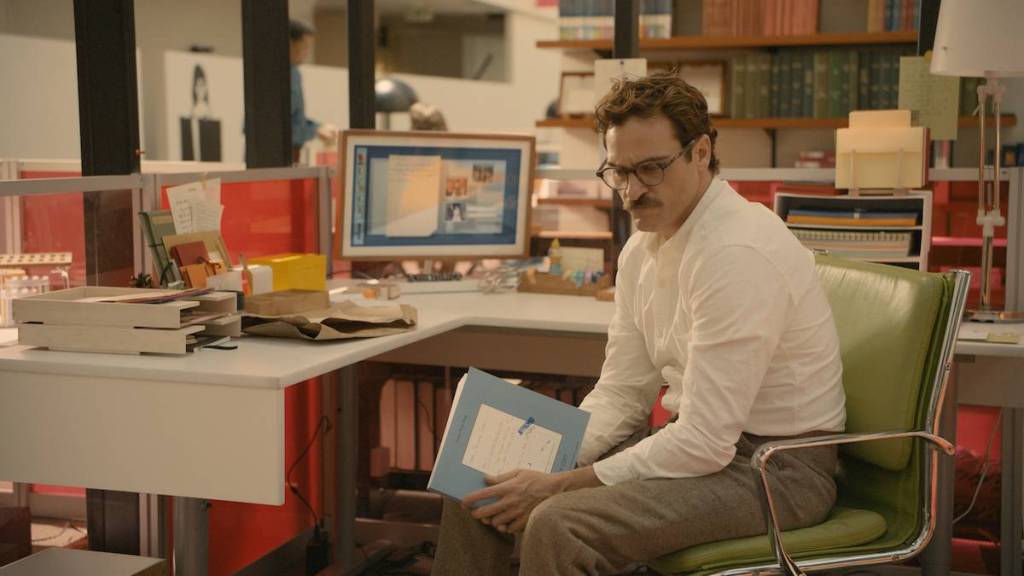
Everyone knows that making a love story narrative is one thing but to make a film’s primary subject matter an emotion can be a difficult concept to capture. So how do you truly capture the raise and fall of a relationship between two people when only one is actually present? While yes, we know Her is a love story in terms of narrative but in terms of a film it’s actually a character study. When you look at the love story narrative you usually have two subjects to look at but Her just has Theodore. Which is an artistic decision that separates it from many other standard romantic portrayals. Theodore’s distinguishing character traits that make him an individual are where the film prioritizes it’s attention. By following many conventions of character studies, Her is able to put us in the shoes of the main character by following Theodore almost exclusively and with that we are able to relate ourselves to him. The world that Theodore inhabits is one of convenience and comfort, a world much like our own. We see this world through his eyes and gain a better understanding of his experiences in life but more importantly he begins his story in a state of unrest. His life is one of detachment and of isolation and showing us just his view is one of the most effective ways to instill a parallel emotional journey with the audience because it encompasses the character’s existence solely to the universe of the film and we know so much about the character that he’s undeserving of such a melancholy experience so we empathize with him. Basically to sum it up, it is the structure of the film that helps us identify with him but it is really the subtle choices of filmmaking techniques where the film is able to develop depth to Theodore’s character arc which makes us relate/empathize with him. Theodore is lost in this state of emotional purgatory and through the creative filmmaking of Jonze his choices are put on display for us to watch as he finds his purpose and struggles with a decision between the lifestyle he wants or the lifestyle he needs.
As many of us know already the dominant theme of Her is loneliness, which is something he is all too familiar with and the notion he doesn’t fit in constantly looming over his head. The film demonstrates this sense of loneliness throughout but is very subtle about it. For example, when we are shown shots of Theodore walking, through a not-so distant futuristic looking Los Angeles, he seems to be traveling along a different path in comparison to the people around him, signifying just how lost he is in this world. Another example and probably a more noticeable film technique is the contrast of his brightly colored attire often making him stand out amongst the more muted hues of his surroundings. He is often clothed in red which we all know is a color most commonly associated with love or passion while the others are in whites and browns. Outside of clothing, the color red shows up in several important scenes and it gives us a deeper understanding of the characters. Red is the color of the couch that Theodore and Catherine (Rooney Mara) share but it is also the color of Samantha, the first love he has found since his separation.
Theodore just doesn’t seem to belong here and then we discover the cause of isolation he feels comes from his recent separation from his wife and the void it has left. The film’s composition exemplifies just how much this solitude plagues him by always showing couples in the shot together but Theodore is alone in the shot with the emptiness of the frame mimicking his internal struggle with loneliness. Like many of us, he counteracts these feelings by avoiding major responsibilities and instead finding activities that give him instant gratification as opposed to any long-term satisfaction. This avoidance and need for instant rewards/pleasure plagues our world just as much as the world Jonze has created. Just like Theodore many people play video games that seem to have no real goal and when it comes to actual solutions to their problems we ignore them and go for the quick and easy fulfillment. These details within the film serve to show that Theodore needs to regain some sort of structure in his life and not only does the film show that he needs to but it manages to also indicate the change that Theodore actually wants in his life. The most common way this is conveyed to us is through the use of montage sequences. There are many scenes where the present is intercut with flashes from Theodore’s past and normally this would be a way of giving us a brief insight into our character’s former life but in Her we learn how the past affects him in the present through the film’s usage of montage theory. I believe that sometimes editing isn’t just about when you decide to cut but where and how you do it. Think of montage theory as a psychological suggestion, for example, take the footage from Theodore’s past without any context and it is heartwarming and a wonderful display of love and affection but when placed strategically next to images of him staring off with a melancholy look on his face it is given new context. Yes, these images within the film still work to teach us about Theodore’s past but the close-up of Theodore’s face proceeds every montage creates another meaning. They indicate the fragmented thoughts of Theodore and through gaining this context we not only learn about his past but also learn about his true desires in life.
Simply through the film’s editing we’ve been able to learn about Theodore’s goals without them being explained to us. The fact that Theodore chooses to think about those memories even though they hurt is because this is the life he yearns for but yet it is his wants that are holding him back from a deeper satisfaction that he needs to be able to find purpose. This is something anyone can relate to especially after a break-up. Eventually Theodore meets Samantha and this evolves to the meaningful connection that Theodore was looking for but as we see in several scenes he remains conflicted and unsure in his decision. I think it is undeniable that Theodore and Samantha do love each other, however, even in their relationship Theodore’s love for his soon to be ex-wife and human interaction is his true desire and his wants remain on display through the continued montage motif. It is here that we see that Theodore doesn’t acknowledge his problem, in fact the only way he can really express his feelings and emotions is through his work. He finds solace in his work where all his deeply felt emotions can be transposed onto others rather than in his own life. Theodore wants that disconnect because his needs are in constant opposition to his wants. We can see he lacks that feeling of purpose and a relationship is the only way that Theodore validates his own existence but the film shows us that if Theodore wants to remove the feeling of loneliness he has to accept that we can’t always get what we want. If he hopes to counteract the sadness he feels he must gain a greater connection with the world around him and it’s in this world that the film shows us Theodore’s needs.

In the world today we can see many advances with things becoming more accessible but I feel there is still this sense of loneliness looming over many people’s heads. I think it’s true that we all long for deep human connection but most of us lack the courage to interact with those around us so we turn inwards. We pick up our phone and disengage, we are unlearning how to interact with those directly around us. The characters in Her are no different for example, if Theodore’s needs are visually illustrated into a disengagement with the surroundings then the film’s use of shallow focus demonstrates just how far Theodore actually is from his goals. Her is pervasive in its use of the shallow focus but it is very specific when it does and doesn’t use it. Almost every shot of Theodore and the skyline of LA shows Theodore in focus and the city out of focus. It is this technique that creates a disconnect between the two subjects because it makes them feel detached from one another. Similar to the techniques used by Sofia Coppola in Lost in Translation, we get this overwhelming sense of loneliness when we see that disconnect between the characters and the city around them. As the film progresses, we establish that the world is what Theodore needs to connect with yet this visual cue suggests as though it is potentially rejecting him. Generally speaking having a subject and their surroundings in focus together is a technique where you learn more about your character through their environment but here it seems as though Theodore has no true home, he is lost. That is until we are shown a few scenes where Theodore and the city are both in focus together. These rare but telling instances directly follow moments where Theodore begins to accept his situation and recognize that perhaps the search for an answer to his loneliness doesn’t lie in pursuit of what he wants but rather accepting what he needs. Whenever Theodore realizes this the closer he comes to gaining that connectivity to his surroundings the film’s shifts into moments of deep focus connecting both Theodore and his world.
During many of the moments when Theodore appears to be happy with Samantha the film begins to subtly change. For example, he wears colors that blend him in more, the lighting becomes warmer and yet at the same time his relation to his world often remains unaltered. These minor tonal shifts come with surprise because the relationship between Theodore and Samantha, no matter how fulfilling is ultimately doomed. The film suggests that the happiness Theodore gains is merely artificial because he hasn’t acknowledged his true problems and he is merely pushing the thoughts of his old life to the back of his mind and that is what is influencing his decisions. This combination of character desires disrupting character needs and purpose is perfectly summed up in one sentence: “that past is just a story we tell ourselves” and the montages of Theodore’s past are the lies that he tells himself. Theodore has become encapsulated to the idea that he can live in a utopia he truly longs for but it has blinded him to so many other aspects of life. This is how the film conveys what the characters personal goals are but in how pursing those goals sadly only removes them from a much grander picture. To find purpose in yourself without being in love with someone else is a lesson I think a lot of us can stand to learn. It is true that kind of love is hard and damn near impossible to find and it is absolutely worth fighting for when you feel it but to learn to not let something so fragile destroy your life and sense of purpose is the most important of lesson of the film.
It can be said that Theodore mirrors many of us by choosing to go with the easy routes in our lives so that we don’t have to address the hardships that we face. The brilliant filmmaking of Her shows us the difference of choosing between what we want against what we need but it also shows us that these issues can be rectified for our character if there is a recognition that the loneliness Theodore feels is an experience shared by everyone. The biggest crime that Theodore commits is that he is unable to see that loneliness is a shared experience because he is caught up in the lie of the past that he doesn’t realize he has veiled his present surroundings, people included. Her shows us that loneliness is a part of life that we must overcome and while Theodore comes to accept that happiness doesn’t always arrive from the places we want it, the final scene represents his acceptance to the life around him. Her is a film that is first and foremost a love story but also raises questions of our place in this universe, the direction our society is going and what it means to be human. It’s a film that challenges us to see the world in a different way, to see ourselves differently and to be grateful to be a part of this world because even with all its heartbreak and chaos it’s all we have and we should make something special out of it. In the end, we can all find meaning in this world and that is love, not just romantic love but love for all things; nature, work, friends and most importantly but sometimes the hardest, ourselves.
“But the heart’s not like a box that gets filled up. It expands in size the more you love.”
Scarlett Johansson, as Samantha
 The Fade Out: A Movie Blog