A Look Inside: Ex-Machina

Alex Garland’s 2014 science fiction film Ex Machina follows a young programmer’s attempts to determine whether or not a humanoid robot possesses a consciousness complicated enough to pass as a real human by administering the Turing test. After watching the film again there are several important themes, elements and hidden meanings that could be derived from it. The film is celebrated for its thought-provoking depiction of the anxiety over whether a non-human entity could actually mimic or exceed human abilities, however by analyzing the early sequences of the film, before artificial intelligence is even introduced into the narrative, the story reveals a compelling examination of humans’ inability to articulate their own thoughts and feelings. In its opening sequence, Ex Machina establishes that it’s not only about the difficulty of creating a machine that can effectively talk to humans, but about human beings who struggle to find ways to communicate with each other in an increasingly digital world.
Ex Machina’s first establishing shots sets the action in a busy, sleek and modern office and it starts off with a woman sitting at a computer, absorbed in her screen. The camera looks at her through a glass wall, one of many in the shot (and many more shots throughout the film). The camera cuts to a few different young men typing on their phones, and the fourth shot peeks over a computer monitor at a blonde-ish man working with headphones in. A slight zoom toward his face suggests that this is an important character to the narrative, and the cut to a point-of-view shot looking at his computer screen confirms this theory. As we later learn that this is Caleb Smith (Domhnall Gleeson), a young programmer whose perspective the film follows and will eventually be the determining factor in the Turing test. The rest of the sequence cuts between shots from Caleb’s P.O.V. and reaction shots of his face, as he receives and processes the news that he has won first prize in a staff competition. Astonished, Caleb dives immediately for his phone and texts several people the news that he has won the competition. Several people immediately respond with congratulatory messages, and after a moment the woman from the initial opening shot runs in to give him an awkward hug. At this point, the other people in the room finally look up, smile, and start clapping, while Caleb smiles disbelievingly—maybe even anxiously—and the camera subtly zooms in a bit closer. Throughout this entire sequence, there is no sound other than ambient electronic music that gets slightly louder and more textured as the sequence progresses. A cut to an aerial view of a glacial landscape ends the opening sequence and indicates that Caleb is very quickly put into a very unfamiliar setting, implying that he will struggle adjusting to this sudden change in circumstances/environment.

Without any audible dialogue or traditional expository setup of the main characters, this opening sequence sets viewers up to make sense of Ex Machina’s visual style and its exploration of the ways that technology can both enhance and limit human communication. The choice to make the dialogue inaudible likely suggests that in-person conversations have no real importance. Human-to-human conversations are most productive in this sequence when they are done through some sort of technology, showcased by everyone being on their phone or in front of a computer. Caleb’s immediate response when he hears his good news is to text his friends rather than tell the people sitting around him, and he makes no move to take his headphones out when the in-person celebration finally breaks out. Everyone in the office is on their phones, looking at screens, or has headphones in, and interestingly enough the camera is looking at screens through Caleb’s viewpoint for at least half of the sequence (a topic we will discuss in a minute).
Rather than simply muting the specific conversations that Caleb has with his coworkers, the ambient soundtrack replaces all the noise that a crowded office in the middle of a workday would ordinarily have. This silence sets the uneasy tone that characterizes the rest of the film, which is as much a horror-thriller than it is a piece of sci-fi. Viewers get the sense that all the sounds that humans make as they walk around and talk to each other are being intentionally filtered out by some presence, replaced with a quiet but eerie electronic beat that marks the pacing of the sequence, slowly building to a faster tempo. Perhaps the sound of people is irrelevant: I think only the visual data matters here. Silence is frequently used in the rest of the film as a source of tension, with viewers acutely aware that it could be broken at any moment. Part of the ‘horror’ of the research bunker, which will soon become the film’s primary setting, is its silence, particularly during sequences of Caleb sneaking into restricted areas and being startled by a sudden noise.
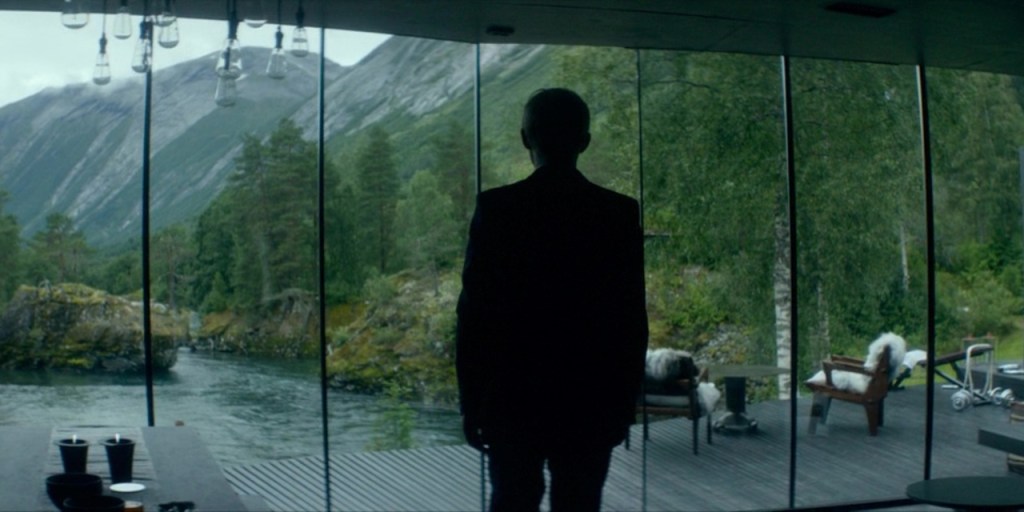
The visual style of this opening sequence reinforces the eeriness of the muted humans and electronic soundtrack. Prominent use of shallow focus to depict a workspace that is constructed out of glass doors and walls makes it difficult to discern how large the space really is and thus the viewer is spatially disoriented in each new setting. This layering of glass and mirrors, doubling some images and obscuring others, is used later in the film when Caleb meets the artificial being Ava (Alicia Vikander), who is not allowed to leave her glass-walled living quarters in the research bunker. The layering of glass and mirrors is also a critical element in the entire home/research bunker of Nathan Bates (Oscar Isaac). Outside a hand-full of scenes there is almost always a glass window or mirror in the shot. The similarity of these spaces visually reinforces the film’s late revelation that Caleb has been manipulated by Nathan, the troubled genius who created Ava.
Now let’s get back to a few other shots in the opening sequence that explicitly hint that Caleb is already under Nathan’s control before he ever even arrives at the bunker. Shortly after the P.O.V shot of Caleb reading the email notification that he won the prize, we cut to a few other P.O.V. shots, this time from the perspective of cameras in Caleb’s phone and computer. These cameras are not just looking at Caleb, but appear to be ‘scanning’ him, as the screen flashes in different color lenses and small points appear around Caleb’s mouth, eyes, and nostrils, tracking the smallest expressions that cross his face. These small details indicate that Caleb is more a part of this digital space than he actually realizes, and also foreshadow the later revelation that Nathan is actively using data collected by computers and webcams to manipulate Caleb and others. The shots from the cameras’ perspectives also make use of a subtle fisheye lens, suggesting both the wide scope of Nathan’s surveillance capacities and the slightly distorted worldview that motivates this unethical and manipulative activity.
Taken all together, the details of Ex Machina’s stylized opening sequence lay the foundation for the film’s long and thoughtful exploration of the relationship between human communication and technology. This sequence, and the film as a whole, ultimately suggests that we need to develop and use new technologies thoughtfully (or carefully) or else the thing that makes us truly human—our ability to connect through language—might be destroyed by our advanced innovations including phones and computers alike. All of the auditory and visual cues in the opening sequence establish a world in which humans are utterly dependent on technology and yet totally unaware of the appalling uses of how a brilliant but unethical person could use it.
“The challenge is not to act automatically.”
Oscar Isaac, as Nathan Bates
 The Fade Out: A Movie Blog
One thought on “The Relationship Between Human Communication and Technology”