
In honor of The Social Network (David Fincher, 2010) premiering at the New York Film Festival (NYFF) opening night on this day back in 2010 I thought I’d take a deep dive into the film and contrast some of the film’s elements with Ayn Rand’s “Screen Guide for Americans.” Why you ask? Well, while the Screen Guide was published back in 1947 at the beginning of the Hollywood Blacklist era and it was developed to point out key “devices used to turn non-political pictures into carriers of political propaganda” (Rand, 1), I feel that the film The Social Network highlights some of the key guidelines outlined within the Screen Guide. During the Hollywood Blacklist many films tried to stay clear of subtly (or not-so subtly) promoting Communist propaganda in Hollywood for fear of drawing attention by the House Un-American Activities Committee (HUAC).
Here is a list of the guidelines:
1. Don’t Take Politics Lightly
2. Don’t Smear the Free Enterprise System
3. Don’t Smear Industrialists
4. Don’t Smear Wealth
5. Don’t Smear the Profit Motive
6. Don’t Smear Success
7. Don’t Glorify Failure
8. Don’t Glorify Depravity
9. Don’t Deify “The Common Man”
10. Don’t Glorify the Collective
11. Don’t Smear an Independent Man
12. Don’t Use Current Events Carelessly
13. Don’t Smear American Political Institutions
Basically a long list of things you shouldn’t do when making a film. Today, thankfully, the fear of Communism is no longer a real threat for us (we’ve got a number of other things to worry about though) so the need for the Screen Guide is out of date and remains un-used. While even being completely obsolete the Screen Guide contains aspects that can be found in films today and even some that go against the devices/guidelines she has listed. While, The Social Network does glorify the independent man and the wealth he has achieved which falls in line with Rand’s guide, it really focuses on the brutal reality of success and how it comes at a cost to oneself and those around them.
Before we dive into a breakdown of the film in relation to the Screen Guide we need to take a look at the beginning of the film when Mark Zuckerberg, wonderfully played by Jesse Eisenberg, is dumped by a woman he had been dating, Erica Albright (Rooney Mara). The first scene of The Social Network really sets the stage for the rest of the film. The camera work is subtle, bouncing between a well framed two-shot and the typical over-the-shoulder shots to highlight one person or the other. While Fincher will get his chance to showcase visuals soon enough, this opening scene is all about Aaron Sorkin’s dialogue. The 9 page scene is furiously paced in typical Sorkin style, with characters basically talking over one another. Comments both clever and snide fire back and forth like bullets whizzing overhead in a war zone. Throughout the scene it is hard to not feel sorry for Zuckerberg, I mean is he an asshole? Probably, but it seems like it’s not necessarily born out of a conscious desire to be one or to hurt those around him. It’s a defense mechanism, carefully constructed over years and years of social awkwardness that he never found a way to grow out of, highlighting his loneliness. All of that launches his idea of making “FaceMash” which compares girls to one another from Harvard. Although the whole idea of “FaceMash” is a cruel concept of ranking the attractiveness of women, Zuckerberg was able to achieve this in a matter of hours. Fincher beautifully showcases the creation of this happening with a fast-paced scene of coding and creating segmented with the fantastic score created by Atticus Ross and Trent Reznor.
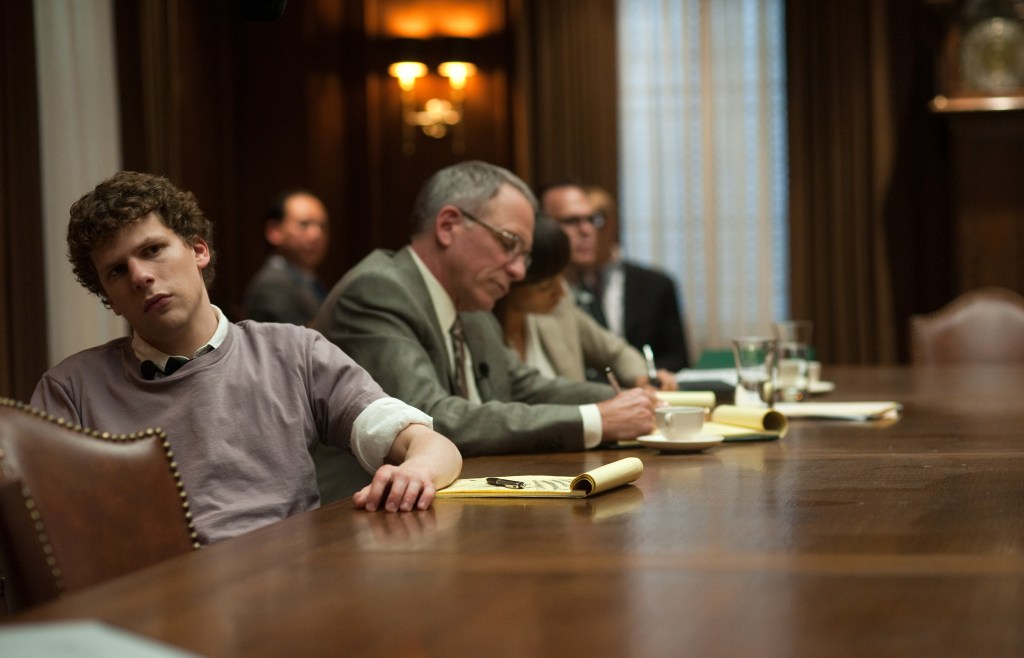
Now let’s breakdown some aspects of Any Rand’s Screen Guide and the elements that are illustrated by Fincher in the film. The concept of the independent man as described by Rand is based solely on ignoring conformity and praising the independent workings of an individual. Mark Zuckerberg is an “independent man” who has his ‘own’ idea of a company that gives people the freedom to express themselves via a social networking site. Sharply contrasted by his best friend Eduardo Saverin (Andrew Garfield) who conforms to the “norms” of college life by getting into a prestigious finals club called The Phoenix. Going along with Rand’s idea of praising the independent individual, Zuckerberg is praised over and over for creating this multi-billion dollar corporation. One thing you’ll notice with David Fincher and his directing of this film is that he makes it a point not to smear Zuckerberg’s idea and carefully outlines all three stories recalling the early days of Facebook. As the story progresses we see Zuckerberg becoming more and more independent (and lonely) and while it seems he wants create the entire site “The Facebook” himself he realizes he needs help from others and gains help from Eduardo on the business front in order to make money. Throughout the film there is this lingering thought that Erica as well as Eduardo are the fuel for a lot of the decisions Zuckerberg makes. This however is the turning point for the glorification of the independent man.
Any Rand states “an independent man [as] one who stands alone and respects the same right of others, who does not rule nor serve, who neither sacrifices himself nor others” (Rand, 9). It is clear that Zuckerberg sacrifices himself as well as his relationships in order to achieve the development, launch and maintenance of Facebook. But does this sacrifice make him less of an independent man? According to Rand, yes it does and also encourages Communist propaganda, however, today and in the real world this sacrifice shows the reality of the success he has gained. Zuckerberg’s character is extremely hard to read throughout the film making it very difficult for many people to understand his real, true and honest intentions. While it might be more of a philosophical debate on if it is possible that these sacrifices make him less of an independent man, it is clear he did what he did at the expense of himself and his relationships.

An independent man such as Mark Zuckerberg and the company he created certainly did not get to where it is today without making some money. From the beginning it was not all about making money for Zuckerberg, it was about giving people what they wanted which was a social networking site far more personal and sophisticated than MySpace or Friendster. He achieved his wealth through production and “through the voluntary exchange of one’s goods or services” (Rand, 4). Zuckerberg voluntarily put his work into the production of Facebook and therefore he received money, wealth and success. In no way did he get his wealth by force; Zuckerberg’s abilities got him to where he is now, not by the forcefulness of others. Fincher really celebrates Zuckerberg’s abilities as a computer programmer which helped him achieve the greatest social networking platform he could create. According to Rand’s words, Fincher and Sorkin have achieved the idea of representing wealth as more than just evil. Some people view making money as being source of evil profit, in some extreme cases. Throughout film history, characters having large amounts of money usually makes them evil, controlling or manipulative, and that might be the case here but in the end Zuckerberg did eventually give Eduardo and the Winklevoss’ some of what they were looking for. Fincher and Sorkin did not represent Zuckerberg as overly greedy; they just portrayed him as an asshole (note the beginning and end scenes). Who knows, maybe those tendencies can be seen as greedy but for me Zuckerberg wasn’t fighting for the greed or the money he was fighting over his right to have done what he did which was create Facebook.
Even with Facebook being a multi-billion dollar company, The Social Network represents Zuckerberg as a man not really interested in money but is at times unclear what his real profit motive is. In the beginning he wanted to develop a website for college kids to let them learn more about each other and like many ideas they are bound to expand and grow, that is sometimes just inevitable. Even after Facebook had been developed and was becoming more and more popular Zuckerberg’s interest in money was minimal. In the meetings that Eduardo set up in New York, Zuckerberg showed no interest in getting investors and to be honest if it was all about the money for Zuckerberg wouldn’t he have had made people pay for using Facebook? When looking at other characters such as the Winklevoss’ (Armie Hammer) and even to an extent Eduardo it was about the profit motive and gaining as much money as possible. Their desire to make money does not coincide with Rand’s idea of not smearing the profit motive because from our perspective they were doing it in a dishonest way. Like any other human when they feel they have been wronged they will do what it takes for justice. It was clear, at least to me, the Winklevoss’ were in it for the money and that’s all they really wanted but in Eduardo’s case it was two-fold. Yes, he wanted to make money but really it was more about getting recognized for his contributions and the success of Facebook.

Now let’s get to one of the most important aspects of The Social Network is the strive for success. According to Rand, “it is the Communist’s intention to make people think that personal success is somehow achieved at the expense of others and that every successful man has hurt somebody by becoming successful” (Rand, 5). Zuckerberg’s success hurt people; it especially hurt his best friend Eduardo. His success with Facebook cost him his best friend and business partner who helped him get the jump start he needed to create the site. Fincher’s intention was not to smear success but that was the reality of the situation. The reality of what actually happened cannot be changed, although Zuckerberg’s success was at the expense of others it was well achieved success. That success cannot be discarded because it has launched the one of the most popular social networks in the world and has connected so many people who otherwise might not have found their long lost cousin. On the DVD cover of The Social Network as well as the IMDB tagline, it reads “You don’t get to 500 million friends without making a few enemies.” What is the reality of success? Well, it is often at times loneliness but it is also the fact that no one can fully gain success without hurting somebody along the way. For example, many people apply for the same job but only one gets it so ultimately that person “hurt” someone by getting the job. It’s like I said above does that person getting the job over you make them an asshole? In this case, not really because it wasn’t your conscious desire to hurt those other people also applying for the job. And while that example might not be considered “success” it is a situation that relates to the same consequences of success. The question remains, does that make a successful person, dishonest or evil? There isn’t a yes or no answer on this but Rand believed that discouraging success at the expense of others was a positive way to stray away from Communism, she believed that personal achievements, like success, go hand-in-hand with dignity and self-respect. Those are two qualities that Zuckerberg did not lack in film.
Going back to that opening scene where the woman who dumped him, Erica, hurt Zuckerberg’s dignity and he had to do something to restore it and not feel as if he had failed. In that opening scene, we are shown that Zuckerberg has great self-respect and at times maybe too much self-respect and self-worth. Along with his dignity, his success in a way was fueled by the damaged he suffered by being dumped (yes, I know that’s debatable). We are then shown another scene of him trying to apologize to her weeks later after the launch of Facebook and as she scornfully rejects his apology he rushes back with the idea of expansion. Finally, at the end of the film we watch as he sits by himself hitting the refresh button after he friend requests Erica after 3 or 4 years. It is this scene that really showcases the loneliness he has suffered as a consequence of the success he has gained and bringing the beginning and the end of the film to a full circle. In the end maybe it wasn’t about success, wealth, dignity or self-respect maybe it was about gaining the respect and friendship from the one person he wanted it from the most.
In 1947, Ayn Rand developed these devices/guidelines that were used to show how non-political films where turned into political ones. During that time period these guidelines helped screenwriters, producers and directors catch Communist propaganda in the films coming out. Today and in the last 50 years in the film industry, these guidelines help develop many themes that are present in films. In most films there is almost always a moral to the story and for The Social Network the moral of the story is that the success of an independent, wealthy person has its consequences. Great success, such as Mark Zuckerberg’s, comes at a cost and that resulted in the ever-ending feeling of loneliness and the sacrifice of friendships.
“You know, you really don’t need a forensics team to get to the bottom of this. If you guys were the inventors of Facebook, you’d have invented Facebook.”
Jesse Eisenberg, as Mark Zuckerberg
Reference: Rand, Ayn “Screen Guide for Americans”
 The Fade Out: A Movie Blog