
WARNING: May Contain Spoilers
From 1946-1965 the American film business was in a time of great struggle and despair, but by the 1960’s things were changing for the film industry. Many films were coming out that showed normal narratives on the top, but had deep psychological questions beneath the surface. Alfred Hitchcock was one of the directors that placed psychological questions underneath the surface of the average thriller. In his popular thriller Psycho (1960), Alfred Hitchcock uses this technique to mask an envious son as a murder. Some of Hitchcock’s characteristic themes are his use of voyeurism, the proximity of normal and abnormal and his uses of Freudian psychology.
Psycho begins with the normal and slow draws the audience into the abnormal. It opens with a scene of Phoenix, Arizona with an exact date and time and then the camera pans into a hotel room with two lovers acting normal. The movie ends with an abnormal parallel between Norman Bates (Anthony Perkins) and his deceased mother, leaving with an undisclosed day and time. Alfred Hitchcock uses the idea of voyeurism in his films to allow the audience to gain pleasure from the narrative. He demonstrates this in the scene in which Norman Bates secretly watches Marion undress herself. Hitchcock makes the audience identify with Marion Crane (Janet Leigh) by making the plot and the theme revolve around her in the first twenty minutes of the film then drastically shifting the plot line and themes towards Norman Bates’ secluded lifestyle. Hitchcock places four major themes into his film, some of which tie into Freudian psychology.
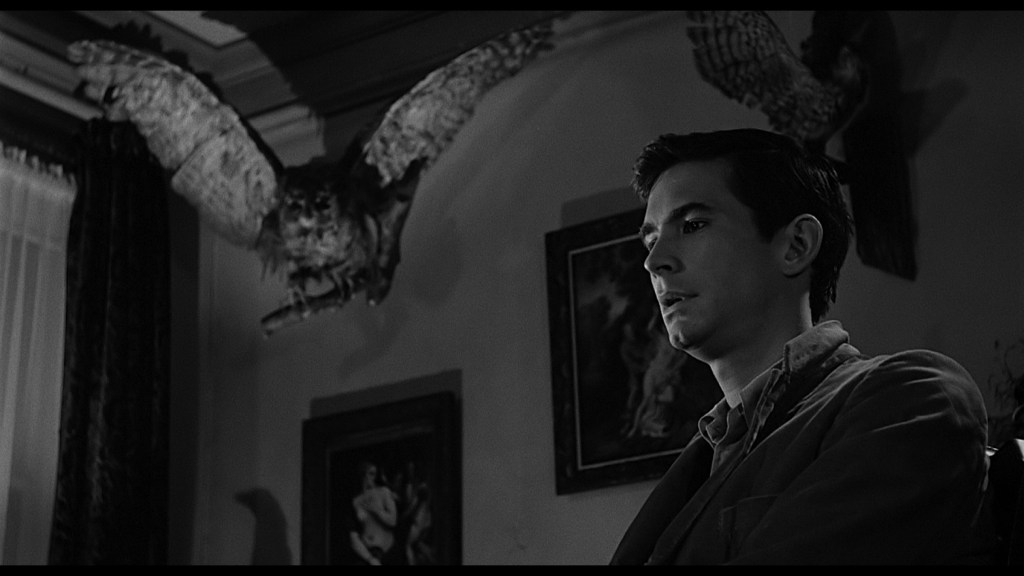
The four major themes in Psycho are money, sex, parent-child relationships and deep psychological problems. The first one to be introduced to the audience is money which is important in the earlier stages of the film and slowly dies away after the memorable shower scene. Money is what brought Marion to the Bates Motel, she stole the money from her employer in order to make things right and proper with her secret lover Sam (John Gavin). The second theme is sex, which is closely related to the money theme. It slowly dies out after the shower scene as well and ultimately is the cause of everything. The film opens with two lovers after they had sex and Norman finds his mother in bed with her lover and kills them both leading to his guilt and unnatural attachment to his mother. Hitchcock makes sex the root of all evil in the end. Sex is what leads “Norman’s mother” to snap and kill any women Norman is in lust with. The third and possibly the most important theme in Psycho is the parent-child relationship almost every character has. Marion has photography’s all over her room and does not want to have sex with Sam in front of her mother’s photography after having dinner with her sister. This is out of respect and along the lines of a normal parent-child relationship. On the other hand there is Norman Bates whose parent-child relationship has dissolved and by the end of the film there is no line between parent and child. Hitchcock turns the normal parent-child relationship into an abnormal one. The fourth and final theme is deep psychological problems which all themes can relate too. There is Marion who is unable to control her actions in a rational manner which the audience can see on numerous occasions. Norman in also unable to control his actions and loses touch with reality and ultimately losing himself to his more dominate mother personality.
List the can go on and on about Hitchcock’s hidden truths in his popular thrill Psycho. Many critics and audience members would not and could not notice the truths he has placed in his films and sometimes even Hitchcock himself could not pull out the truths in his films. Despite the rough patch in film history during this time period Hitchcock was able to make Psycho into one of the biggest films of his career and one of the biggest thrillers in film history. It was the first psychological thriller and its great twist leaves the audience in a state of complete confusion and utter fear.
 The Fade Out: A Movie Blog