WARNING: May Contain Spoilers!
The film industry in the 1960’s was known for its psychological horrors and its science-fiction fantasy films, but there is one movie that stands out among those genres and it is called The Graduate (1967) directed by Mike Nichols. This comedy-drama is based on the 1963 book with the same name written by Charles Webb. The main character Benjamin Braddock (Dustin Hoffman) has just graduated from a college “back east” and he is left with the intimidating decision of what to do next. The Graduate focuses on Benjamin Braddock’s overwhelming desire to escape from the suburban and materialistic life of his parents and his discovery of manhood.
The Graduate starts off with one of Mike Nichols’ most informative sequences in which Benjamin is suffering through a graduation party his parents have thrown for him among his return home from an Ivy League college. At this so-called graduation party Ben finds that his parents have invited all of their older friends. For Ben this leads to pointless and boring conversations throughout the evening. The whole graduation party scene is shot with a handheld camera and is captured with many close-ups to reflect the crowding of the partygoers. All through the scene the camera follows Ben who is nervous and frantic, the close-ups help emphasize his feelings of suffocation. Ben’s sense of suffocation is summed up in an important conversation with Mr. McGuire (Walter Brooke) that sets a theme for the rest of the film. In attempts to avoid the party Ben finds himself having an in-depth conversation with Mr. McGuire about his future. Mr. McGuire being the kind suburban man he is, offered Ben a friendly word of advice focusing on prospects of the future and his profession. He believes Ben should think of only his future in terms of a single word and it is “plastics.” For Ben this is the exact lifestyle he so desperately wanted to avoid, and he greatly feared. The conversation leads Ben to the realization that he needs to discover his “manhood” as well as his search for an identity apart from the world of his parents. It is also notable that the conservation between Ben and Mr. McGuire takes place poolside. The use of the backyard pool throughout the first half of the film symbolizes the depths of suburban life. Nichols’ use of the swimming pool is a reminder and a “reflection” of the submerging feeling associated with suburban life. Nichols is trying to link Ben and the swimming pool through an uneasy relationship centered on the emasculating effect of the suburban and materialistic lifestyle.
After the horrifying conservation with Mr. McGuire, Ben runs upstairs to avoid everyone and everything only to look down at the swimming pool of suburbia and ultimately his inevitable future. Then Mrs. Robinson (Anne Bancroft) stumbles through the door and forces Ben to take her home. At the Robinson’s house the tension is high, and this scene sets up the affair Ben and Mrs. Robinson engage in for a good portion of the film. After that, the nervous Ben continues to meet with Mrs. Robinson at the Taft Hotel escalating the relationship. After a summer long affair Mrs. Robinson and Ben end their relationship when he is forced to take out her daughter, Elaine (Katharine Ross) by the pressure of his parents and Mr. Robinson (Murray Hamilton). Elaine finds out about the affair and goes back to UC Berkeley, where Ben follows and subsequently stalks her. She is then forced to marry a frat boy that would give her entrance to the same suburban life as her parents. After finding this information out Ben runs frantically all over Santa Barbara to find Elaine and make her change her mind.

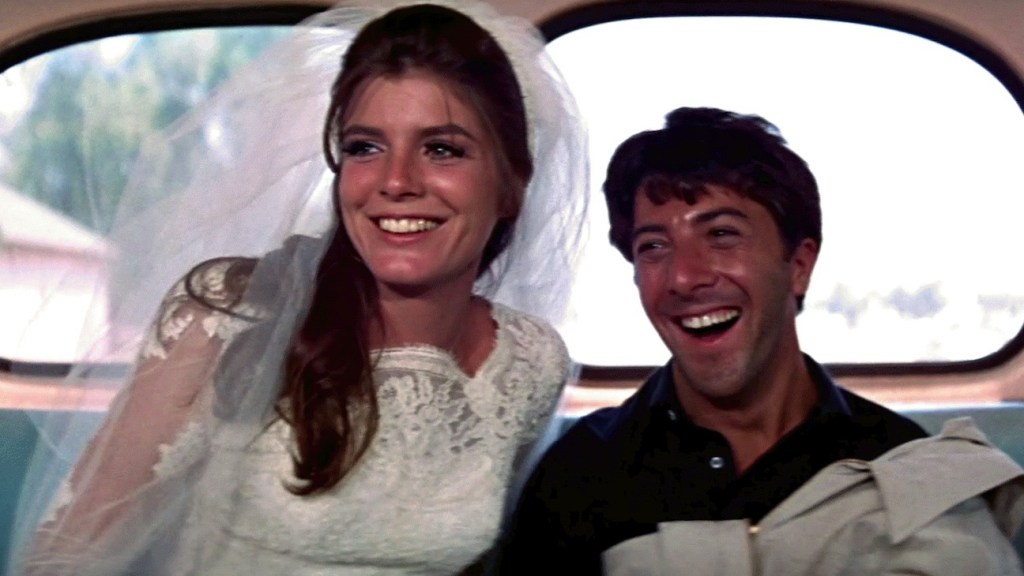
Although there is not much emphasis on Elaine she is dealing with the same issues as Ben. Mrs. Robinson’s disapproval of Ben dating Elaine is a pivotal point for the three characters. Once Ben falls in love with Elaine he rejects Mrs. Robinson and the two lovers are able to escape (or so it seems) the suburban lifestyle. Their relationship enrages Mrs. Robinson because Elaine is the reason for her own suburban existence and the truth comes out in the end sequence at the church. Mrs. Robinson did not want Elaine to be with Ben because in her opinion he could give her the future she so desperately wanted. As everyone is fighting Mrs. Robinson grabs Elaine and says, “it’s too late” referring to the fact that she is stuck in the same upper-middle class suburban life as her, but Elaine responds with “not for me!” as her and Ben run away. Successful, the two lovers find themselves on a bus with no where to go and the future they so desperately tried to avoid right in front of them. The final shot of Benjamin and Elaine is the most popular and notable shots in the film. As the two stumble to the back of the bus in the pure bliss and excitement of having escaped the “plastic” suburban world, they soon realize they have taken the first step toward that plastic world. Nichols does not directly emphasize this idea, but their facial expressions say it all. The camera then goes to an extreme long shot of the bus driving into the suburbs of Santa Barbara, right back into the materialistic lifestyle of their parents.
Throughout the film there are many motifs and elements that hint at the three main themes of the film. The first and most important theme is the desire to escape the suburban and materialistic life. The scuba gear he received for his birthday is the most important motif used to emphasize the desire to escape. The scuba gear represents so much more than a simple scuba suit and snorkel it represents the longing to escape the waters of materialism and suburban life. The introduction of the scuba gear comes at the time of Ben’s twenty-first birthday party. This scene also takes place in the backyard by the swimming pool. Ben is embarrassed by what is going on and feels stupid for agreeing to do the demonstration of the scuba suit. After a long introduction by Mr. Braddock (William Daniels) Ben emerges from inside the house and it shifts to a subjective camera from Ben’s point of view. In this point of view shot the only thing being heard is Ben’s heavy breathing and nothing from the outside world. Nichols shifts to Ben’s perspective to focus on his sense of isolation from everyone around him, especially his parents. After entering the water Ben tries to get out but is only pushed back into the water by his parents. The pushing back of Ben underscores his parents’ desire for him to become a part of their materialistic suburban existence. Ben finally gives in and falls to the bottom of the swimming pool, the camera then shits from the point of view shot to a zooming out from a medium shot to a long shot of Ben standing alone in the watery depths of suburbia. While the long shot image of Ben standing at the bottom of the swimming pool takes place, the first phone call between him and Mrs. Robinson plays in the background. The long shot of Ben and the phone conservation is a link between the submerging feeling of water and his desire for a sexual relationship with Mrs. Robinson. This link is reinforced by going back and forth between scenes of the swimming pool and the affair. The affair between the two is also linked to Ben’s search for his own manhood.
The second theme is Ben’s search for manhood. Ben’s sexual affair with Mrs. Robinson is created from his desire to prove his manhood. Their relationship is probably the most important detail in discovering his manhood. The affair arises in resistance towards the emasculating power of his parents. An important reason Ben picks Mrs. Robinson is that she makes herself available to him and he finds her to be a motherly object of desire. Nichols draws a comparison between Mrs. Robinson and Mrs. Braddock (Elizabeth Wilson); he makes Mrs. Robinson a replacement for Ben’s mother. The relationship between the two gives Ben the reassurance of his manhood something his parents try and take away. Throughout the film everyone is constantly emasculating Benjamin, but even Ben finds himself caught between childhood and adulthood. This feeling of uncertainty in self-identity is closely linked with the theme of entrapment.
Nichols wastes no time in setting up the theme of entrapment by placing it in the opening credits. A close-up of Ben’s emotionless face draws back to show him on a plane descending into LAX airport. This shot is accompanied by a medium shot of Ben on a conveyor belt enclosed against a plain white wall. The shot of a motionless Ben sets the narrative tone for the film, showing him on a conveyor belt being ushered back to suburbia against his own willingness and desire. After the opening credits fade out there is a shot of Ben gazing longingly into his fish tank back at his parents’ house in Southern California. The use of the fish tank and water highlights his feelings of entrapment. To make things even better at the bottom of the fish tank there is a mini plastic figurine in a scuba suit, which is a foreshadowing of his own fate in a later scene. Ben is then forced to go downstairs and talk with “his” guests at the graduation party which causes him to feel suffocated and nervous. His own suffocation is another cause of his feelings for entrapment and even isolation. His feelings of suffocation are constant in the entire film even to the very end.
In the end, whether the uncertainty of the future is a good or bad fortune, Benjamin is stuck in the same situation he was when the film started maybe even a bit more lost. The powerlessness of both protagonists, Ben and Elaine, leaves one to wonder if it is possible to escape the overwhelming sense of entrapment and emasculating feelings of a suburban and materialistic existence. The Graduate does its job of internalizing the suburban life so many people try and avoid but, in the end, it is inevitable to run away from something that is bound to happen.
 The Fade Out: A Movie Blog